
Global Non-Destructive Testing (NDT) Market Outlook
The Global Non-Destructive Testing (NDT) Market is witnessing sustained growth as industries increasingly prioritize asset reliability, operational safety, predictive maintenance, and regulatory compliance across critical infrastructure. Non-destructive testing technologies have become indispensable for detecting structural defects, evaluating material integrity, and extending the service life of industrial assets without causing damage. As sectors including aerospace, automotive, oil & gas, power generation, manufacturing, marine, and infrastructure continue investing in digital inspection solutions, the demand for advanced NDT equipment, AI-enabled inspection platforms, and automated testing systems is accelerating worldwide.
According to Quintile Insights, the Global Non-Destructive Testing (NDT) Market is projected to grow from USD 25.04 Billion in 2026 to USD 51.43 Billion by 2036, reflecting robust long-term opportunities driven by industrial modernization, stringent quality standards, aging infrastructure rehabilitation, renewable energy expansion, and the growing adoption of Industry 4.0 technologies. Organizations are increasingly integrating artificial intelligence, robotics, machine vision, digital radiography, cloud-based analytics, and predictive maintenance platforms to improve inspection accuracy, reduce operational downtime, and optimize asset lifecycle management.
This comprehensive market research report provides an in-depth evaluation of the evolving competitive landscape, emerging technology trends, investment outlook, regulatory developments, and supply chain dynamics shaping the global NDT industry. The study examines the adoption of advanced inspection methods across major end-use industries while assessing macroeconomic factors, capital investments, digital transformation initiatives, sustainability objectives, and evolving international safety standards influencing future market growth.
The report delivers detailed market intelligence across components, testing methods, inspection technologies, end-use industries, and regional markets, offering actionable insights into revenue opportunities, demand outlook, technological advancements, and strategic business developments. It further evaluates innovation trends, product commercialization strategies, mergers & acquisitions, partnership activities, competitive benchmarking, pricing analysis, and company positioning to help stakeholders identify emerging growth avenues and strengthen their market presence.
Designed for equipment manufacturers, inspection service providers, technology developers, investors, regulatory organizations, OEMs, distributors, consulting firms, and corporate decision-makers, this study serves as a reliable strategic resource for understanding market evolution, identifying high-growth investment opportunities, evaluating competitive positioning, and supporting informed business decisions throughout the forecast period.
Global Non-Destructive Testing (NDT) Market Trends and Insights
The evolution of industrial inspection technologies is creating new opportunities across the global Non-Destructive Testing (NDT) Market. Organizations are increasingly investing in intelligent inspection solutions capable of delivering higher accuracy, improved productivity, and enhanced regulatory compliance while reducing operational costs.
Artificial intelligence is emerging as one of the most transformative trends within the industry, enabling automated defect recognition, predictive analytics, and real-time inspection reporting. Similarly, portable and wireless NDT equipment is improving inspection efficiency in remote and hazardous environments, particularly across oil & gas, mining, offshore energy, and infrastructure projects.
Growing adoption of Industry 4.0 technologies has accelerated the integration of cloud computing, Industrial Internet of Things (IIoT), digital twins, and connected inspection platforms into asset management systems. These technologies allow organizations to continuously monitor equipment health, optimize maintenance schedules, and reduce costly production downtime.
Sustainability objectives are also influencing technology adoption, encouraging industries to replace conventional inspection methods with environmentally friendly digital inspection systems that minimize waste generation and improve operational efficiency. In parallel, increasing investments in electric vehicles, semiconductor manufacturing, renewable energy infrastructure, hydrogen projects, and aerospace manufacturing continue expanding the application scope of advanced NDT technologies.
Drivers Impact Analysis
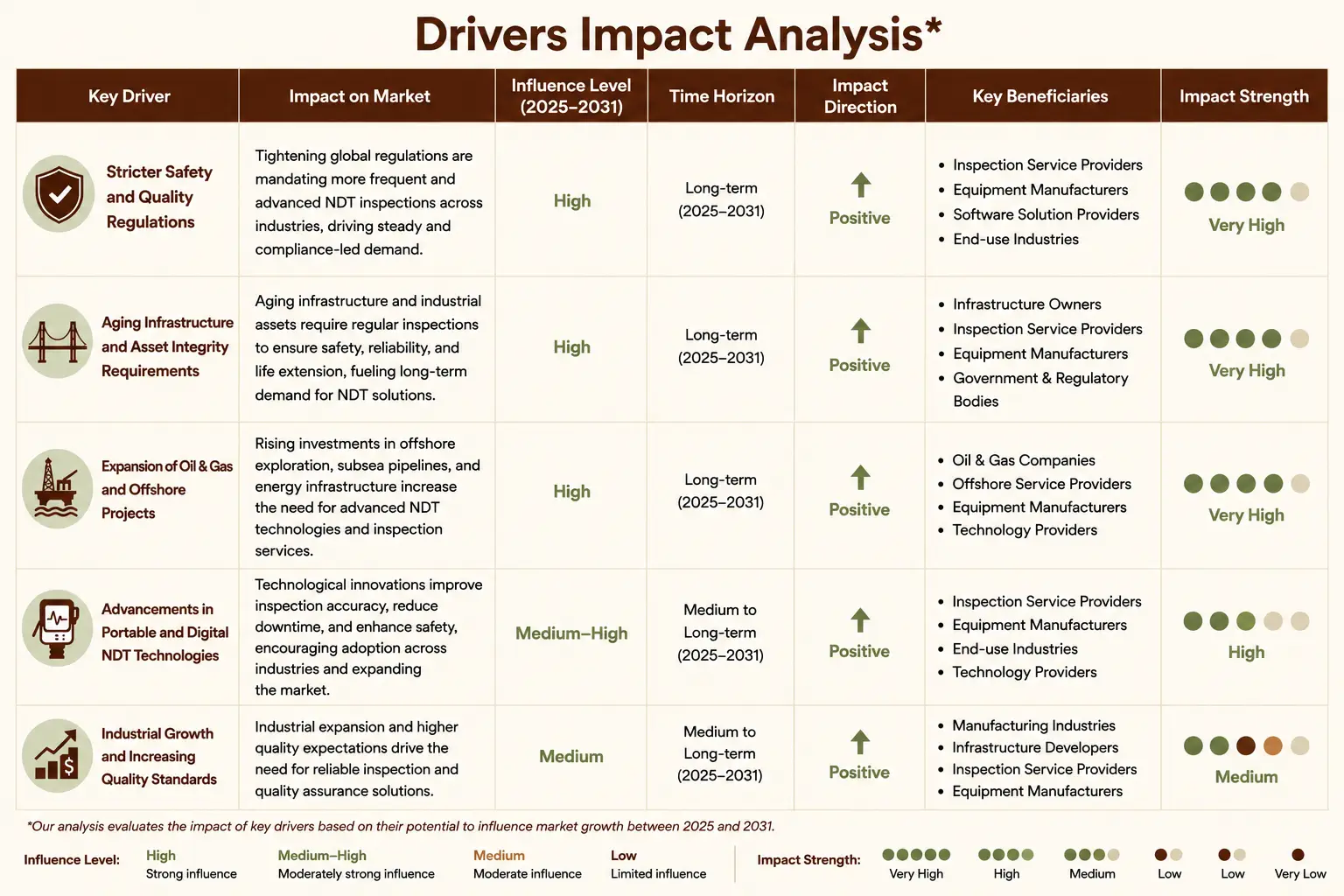
Increasing Regulatory Compliance Requirements Strengthen Long-Term Market Demand
The implementation of increasingly rigorous industrial safety regulations across sectors such as aerospace, power generation, manufacturing, oil & gas, and transportation continues to create sustained demand for non-destructive testing solutions. Regulatory organizations worldwide are placing greater emphasis on periodic inspection, asset integrity verification, and quality assurance to minimize operational risks and improve public safety. As compliance requirements become more stringent, industries are investing in advanced inspection technologies including phased-array ultrasonic testing, digital radiography, and automated reporting systems. These regulatory developments are transforming NDT from a maintenance support function into a critical compliance requirement, encouraging organizations to modernize inspection capabilities and establish long-term testing programs.
Aging Industrial Infrastructure Drives Continuous Inspection Requirements
A significant proportion of industrial facilities, transportation networks, energy infrastructure, and utility assets worldwide are approaching or exceeding their intended operational lifespan. Aging pipelines, bridges, refineries, power plants, offshore structures, and manufacturing facilities require regular structural assessments to ensure safe operation and extend asset life. This growing need for condition monitoring has accelerated investments in advanced inspection technologies capable of identifying corrosion, fatigue, weld defects, and material degradation before failures occur. Infrastructure modernization initiatives across both developed and emerging economies are expected to generate consistent demand for high-performance NDT equipment and specialized inspection services throughout the forecast period.
Expansion of Energy and Offshore Projects Creates New Growth Opportunities
Rising investments in offshore oil & gas exploration, liquefied natural gas infrastructure, petrochemical facilities, offshore wind farms, and subsea pipeline networks are expanding the application scope of advanced non-destructive testing technologies. These environments demand highly reliable inspection systems capable of operating under harsh conditions while ensuring structural reliability and operational safety. As energy operators seek to reduce unplanned shutdowns and optimize asset performance, the adoption of remotely operated inspection systems, robotic testing solutions, and real-time monitoring technologies continues to increase. The expansion of global energy infrastructure is expected to remain a major contributor to market growth over the coming decade.
Portable Digital Inspection Technologies Enhance Operational Efficiency
Continuous innovation in portable inspection equipment is transforming field-based non-destructive testing operations. Lightweight ultrasonic instruments, digital radiography systems, wireless sensors, and cloud-connected inspection devices enable technicians to perform faster and more accurate evaluations across remote industrial environments. These technologies improve inspection productivity, reduce reporting time, and minimize operational disruptions by enabling immediate data analysis and centralized decision-making. As organizations increasingly prioritize efficiency, mobility, and predictive maintenance, demand for portable digital inspection solutions is expected to accelerate across multiple industries.
Restraints Impact Analysis*
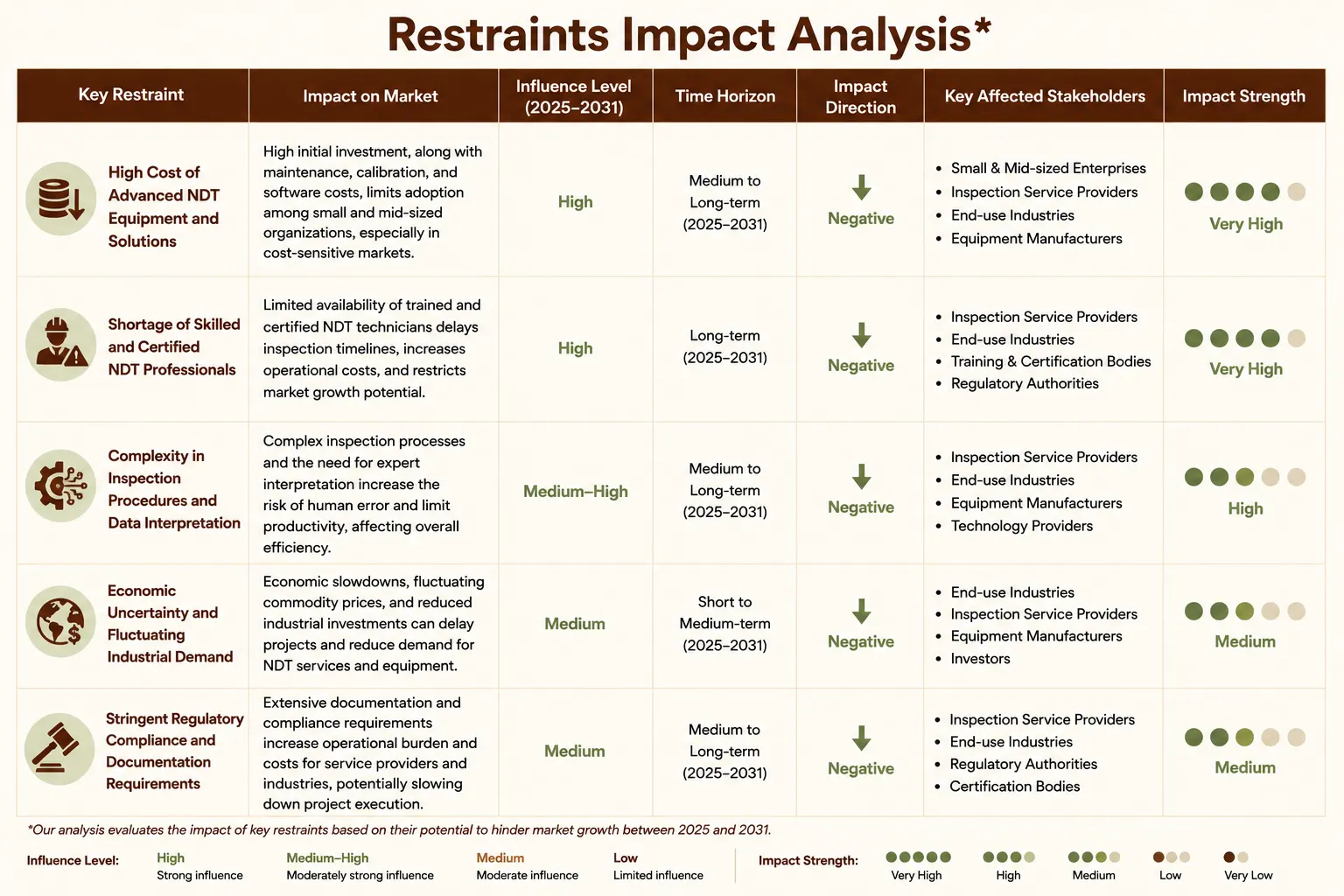
High Capital Investment Limits Adoption of Advanced Inspection Systems
Although automated inspection technologies deliver significant long-term operational benefits, their high acquisition and implementation costs remain a major challenge for many organizations. Advanced robotic inspection platforms, phased-array ultrasonic systems, computed tomography equipment, and AI-enabled software require substantial capital investment, ongoing calibration, software licensing, and workforce training. These financial barriers are particularly significant for small and medium-sized enterprises operating in cost-sensitive markets, where conventional inspection techniques continue to represent a more economical alternative. Until equipment affordability improves, investment costs are expected to remain a limiting factor for widespread technology adoption.
Limited Availability of Skilled NDT Professionals Restrains Market Expansion
The growing complexity of modern inspection technologies has increased demand for highly qualified and certified non-destructive testing professionals. However, the industry continues to face shortages of experienced inspectors capable of operating sophisticated equipment and interpreting complex inspection data. Lengthy certification processes, specialized technical training, and an aging workforce have created a widening skills gap across many industrial sectors. Although artificial intelligence and automated inspection software can improve productivity, certified personnel remain essential for validation, regulatory compliance, and final inspection approval, making workforce availability a persistent challenge for market growth.
By Testing Method: Advanced Ultrasonic Technologies Maintain Leadership While Emerging Techniques Gain Momentum
Ultrasonic testing continues to represent one of the most widely adopted inspection methods owing to its high accuracy, versatility, and ability to detect internal material defects across a broad range of industrial applications. The increasing use of phased-array ultrasonic systems has significantly improved inspection speed, imaging quality, and defect characterization, making the technology suitable for complex infrastructure, aerospace components, pipelines, pressure vessels, and manufacturing equipment.
At the same time, advanced inspection techniques such as Eddy Current Testing, Computed Tomography, Digital Radiography, Infrared Thermography, and Acoustic Emission Testing are witnessing growing adoption as manufacturers require greater precision for inspecting lightweight materials, composite structures, and high-performance engineering components. Rather than replacing conventional techniques, these technologies are expanding inspection capabilities by enabling organizations to select the most appropriate testing solution based on material characteristics, operational conditions, and regulatory requirements.
By Technique: Artificial Intelligence Accelerates the Evolution of Smart Inspection Systems
Conventional inspection techniques continue to dominate industrial applications due to their proven reliability and broad regulatory acceptance. However, artificial intelligence is rapidly reshaping the future of non-destructive testing by improving inspection speed, defect recognition accuracy, and predictive maintenance capabilities.
AI-powered image analysis, machine learning algorithms, and automated defect classification enable inspection teams to process complex datasets with greater consistency while reducing manual interpretation time. Integration with cloud-based analytics, digital twins, and Industrial Internet of Things (IIoT) platforms allows organizations to monitor asset conditions continuously and predict equipment failures before operational disruptions occur. As industries pursue greater automation and digital transformation, intelligent inspection technologies are expected to become a major source of competitive advantage throughout the forecast period.
By End-use Industry: Industrial Expansion Broadens Application Across Critical Infrastructure
The oil & gas industry continues to generate significant demand for non-destructive testing due to stringent inspection requirements for pipelines, pressure vessels, refineries, offshore facilities, and petrochemical assets. Maintaining operational integrity and meeting increasingly strict safety regulations remain key priorities for energy operators worldwide.
Beyond traditional energy applications, rapid growth is being observed across the automotive, aerospace & defense, renewable energy, electronics, construction, and heavy manufacturing sectors. Electric vehicle production, battery manufacturing, wind energy projects, semiconductor fabrication, and advanced infrastructure development all require highly accurate inspection methods to ensure product quality, structural reliability, and regulatory compliance. This diversification of end-use applications is expanding the addressable market and creating new opportunities for advanced inspection technologies.
Regional Analysis
North America
North America continues to represent a mature and technologically advanced market, supported by well-established industrial infrastructure, rigorous safety regulations, and early adoption of digital inspection technologies. Ongoing investments in energy infrastructure, aerospace manufacturing, transportation networks, and industrial modernization continue to support demand for advanced non-destructive testing solutions. The region also benefits from strong adoption of AI-enabled inspection platforms and predictive asset management systems.
Europe
Europe remains an important regional market driven by stringent quality standards, sustainability initiatives, and continuous investments in industrial modernization. Increasing deployment of renewable energy infrastructure, electric vehicle manufacturing, railway modernization, and advanced manufacturing technologies is creating additional opportunities for inspection equipment suppliers and service providers. Regulatory emphasis on environmental compliance and operational safety continues to encourage adoption of digital inspection systems across multiple industries.
Asia-Pacific
Asia-Pacific is expected to register the strongest growth throughout the forecast period due to rapid industrialization, expanding manufacturing capacity, infrastructure development, and increasing investment in aerospace, automotive, electronics, and renewable energy sectors. Countries including China, India, Japan, and South Korea are strengthening industrial quality standards while accelerating adoption of advanced manufacturing technologies, creating substantial demand for next-generation non-destructive testing solutions.
Latin America
Latin America is witnessing gradual expansion supported by investments in mining, energy production, transportation infrastructure, and industrial development. Growing awareness of preventive maintenance practices and increasing emphasis on operational safety are encouraging greater adoption of inspection technologies across both public and private sector projects.
Middle East & Africa
The Middle East & Africa region continues to present long-term growth opportunities due to ongoing investments in oil & gas production, petrochemical facilities, power generation, marine infrastructure, and large-scale construction projects. Increasing focus on asset integrity management, operational reliability, and international safety compliance is expected to accelerate demand for advanced inspection equipment and specialized NDT services across the region.
Competitive Landscape
The global Non-Destructive Testing (NDT) Market is characterized by a moderately competitive environment where established multinational companies compete alongside specialized regional service providers. Market participants are increasingly expanding their capabilities through strategic acquisitions, technology partnerships, product innovation, and geographic expansion to strengthen their market position.
Competition is shifting beyond inspection equipment toward integrated digital solutions that combine advanced hardware, AI-powered software, cloud-based analytics, remote monitoring, and lifecycle asset management services. Companies capable of delivering end-to-end inspection ecosystems, regulatory expertise, and industry-specific solutions are expected to gain a stronger competitive advantage as industrial customers seek comprehensive inspection and maintenance partners.
Recent Industry Developments
- January 2026: Several leading NDT solution providers expanded their AI-powered inspection portfolios by integrating machine learning algorithms with ultrasonic and digital radiography systems, enabling faster defect identification, improved inspection accuracy, and predictive maintenance capabilities across industrial assets.
- November 2025: Major inspection technology companies introduced next-generation portable phased-array ultrasonic testing (PAUT) and wireless digital radiography systems designed to improve field inspections, minimize downtime, and enhance real-time data sharing through cloud-based inspection platforms.
- September 2025: Strategic collaborations between industrial automation providers and non-destructive testing equipment manufacturers accelerated the integration of Industrial Internet of Things (IIoT), robotics, and digital asset management solutions, supporting smarter inspection workflows and condition-based maintenance programs.
- July 2025: Several global inspection service providers expanded their operations through acquisitions and regional partnerships to strengthen capabilities across aerospace, oil & gas, renewable energy, and infrastructure inspection services while broadening their international customer base.
- May 2025: Manufacturers increased investments in AI-assisted visual inspection, computed tomography (CT), and automated defect recognition technologies to address rising demand for high-precision quality assurance in electric vehicle batteries, semiconductor manufacturing, and advanced composite materials.
- March 2025: Industry participants accelerated the development of cloud-enabled inspection management software, allowing organizations to centralize inspection records, automate compliance reporting, and improve lifecycle asset management across multiple industrial facilities.
- January 2025: Growing investments in offshore energy, hydrogen infrastructure, and renewable power projects encouraged the adoption of robotic inspection systems, remotely operated vehicles (ROVs), and advanced corrosion monitoring technologies for critical industrial assets.
Global Non-Destructive Testing (NDT) Market Report Scope
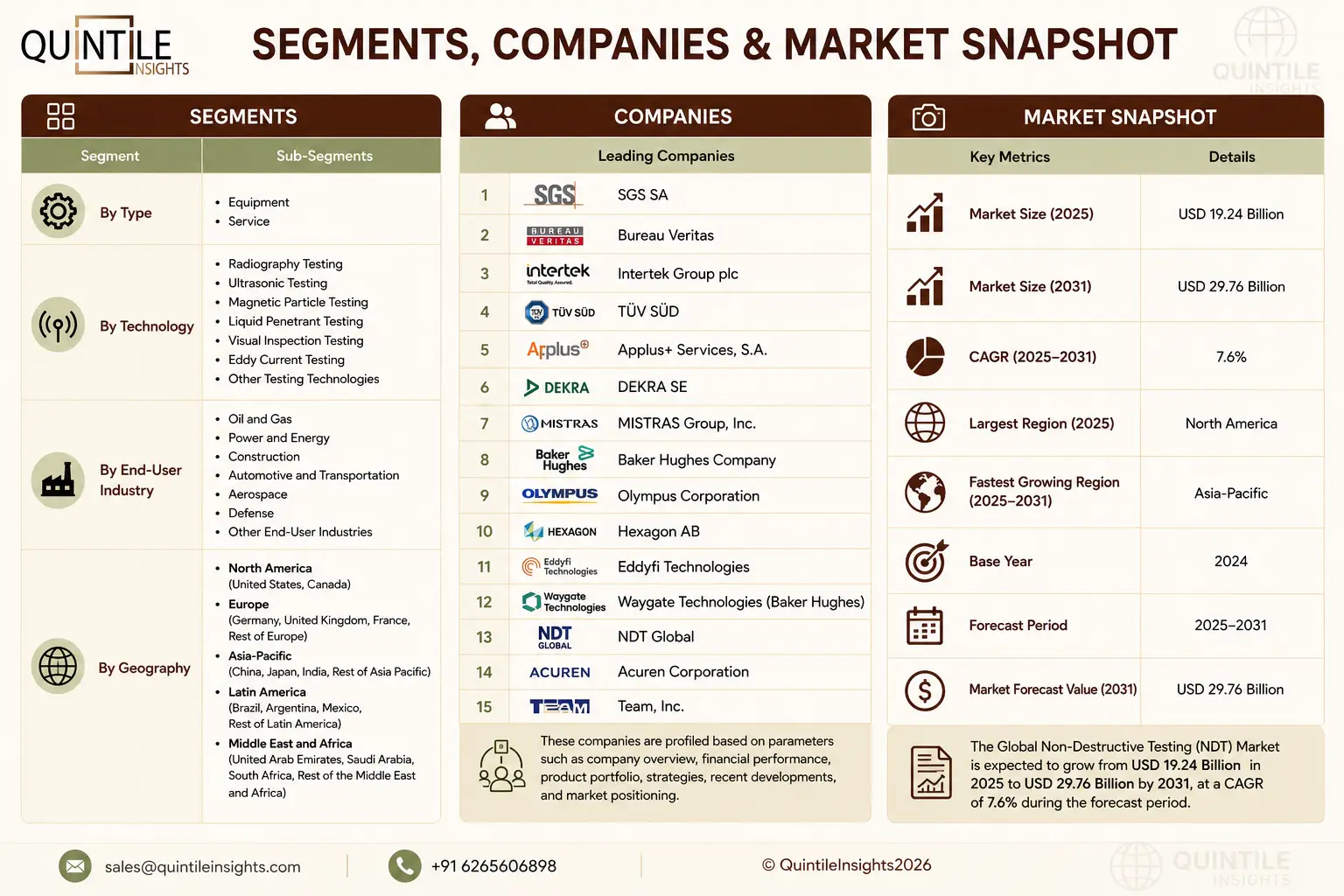
The Global Non-Destructive Testing (NDT) Market Report provides a comprehensive assessment of the technologies, equipment, software, and inspection services used to evaluate the integrity, quality, and performance of materials, components, and industrial assets without causing physical damage. Non-destructive testing plays a vital role in ensuring operational safety, regulatory compliance, product quality, and asset reliability across industries where equipment failure can result in significant financial, operational, or environmental consequences.
This study examines current market trends, technological advancements, competitive dynamics, regulatory developments, and investment opportunities shaping the global NDT industry. The report evaluates the increasing adoption of advanced inspection technologies, including AI-enabled analytics, digital radiography, phased-array ultrasonic testing, computed tomography, infrared thermography, and automated inspection systems, as industries continue to accelerate digital transformation and predictive maintenance initiatives.
The report offers detailed market sizing, historical analysis, and forecast estimates (USD Billion) across multiple market segments. It provides strategic insights into market drivers, restraints, emerging opportunities, industry challenges, competitive benchmarking, regional growth patterns, and technological innovation to support informed business and investment decisions.
The market is segmented by Component, Testing Method, Technique, End-use Industry, and Region, enabling stakeholders to evaluate growth potential across diverse industrial applications and geographic markets.
The study serves as a valuable resource for equipment manufacturers, inspection service providers, technology developers, investors, government organizations, OEMs, distributors, and industrial decision-makers seeking to understand market evolution, competitive positioning, and future growth opportunities within the global Non-Destructive Testing (NDT) industry.
Frequently Asked Questions
Choose License Type

Personalize Research
- Request for free customization
- Buy country specific report
- Ask for Subscription Package
- Ask special pricing
- Ask for Analyst call support
Get in Touch
+91-619-645-6280
+44-219-314-7779
sales@quintileinsights.com