Smart TV Market Overview

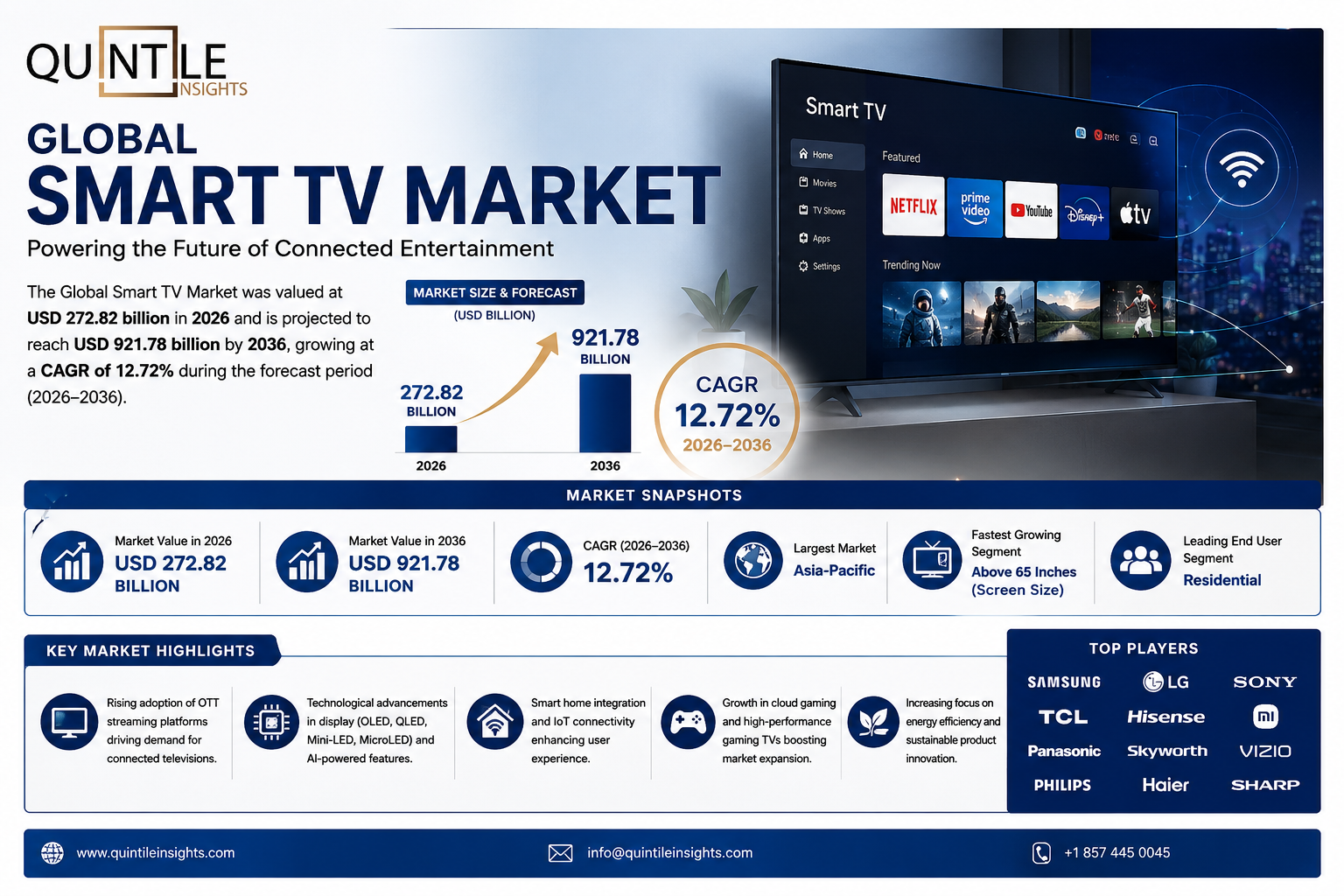
The Global Smart TV Market was valued at USD 272.82 billion in 2026 and is projected to reach USD 921.78 billion by 2036, expanding at a CAGR of 12.72% during the forecast period (2026–2036).

The global smart TV market is undergoing a significant transformation as televisions evolve from traditional display devices into fully connected digital entertainment hubs. The integration of advanced operating systems, artificial intelligence (AI), cloud computing, voice recognition, and Internet of Things (IoT) connectivity has fundamentally changed consumer expectations. Modern smart TVs now serve as centralized platforms for streaming content, gaming, smart home management, video conferencing, and personalized entertainment experiences, making them an essential component of connected households worldwide.

Growing internet penetration, expanding broadband infrastructure, and increasing adoption of high-speed 5G networks continue to strengthen market demand. Consumers are increasingly shifting away from conventional cable television toward Over-the-Top (OTT) streaming services, creating sustained demand for smart televisions equipped with integrated applications and seamless internet connectivity. The rapid expansion of platforms such as Netflix, Disney+, Amazon Prime Video, YouTube, Apple TV+, regional streaming services, and live sports platforms has significantly accelerated replacement cycles for televisions across both developed and emerging economies.

Technological advancements remain one of the strongest growth catalysts for the industry. Manufacturers are investing heavily in OLED, QLED, Mini-LED, MicroLED, Quantum Dot, and 8K display technologies to deliver superior picture quality, improved brightness, wider color gamut, and enhanced energy efficiency. Simultaneously, artificial intelligence-powered image processing, adaptive brightness controls, automatic content optimization, and voice-enabled virtual assistants have become standard features across premium and mid-range smart television models.


The gaming ecosystem has also emerged as an important revenue contributor. Increasing popularity of cloud gaming, high-refresh-rate displays, HDMI 2.1 compatibility, VRR (Variable Refresh Rate), and ultra-low latency technologies has positioned smart TVs as preferred displays for gaming consoles and online gaming platforms. The convergence of gaming, entertainment, and smart home functionality continues to create new opportunities for television manufacturers.

Consumer purchasing behavior is increasingly influenced by larger screen sizes and premium viewing experiences. Demand for televisions exceeding 55 inches has grown steadily across residential and commercial sectors, supported by declining panel prices and rising disposable incomes. Ultra-high-definition (UHD), 4K, and emerging 8K televisions are becoming mainstream as content availability continues to improve across streaming services and broadcasting networks.

Artificial intelligence is reshaping product innovation across the market. AI-powered recommendation engines, multilingual voice assistants, facial recognition, gesture control, automatic calibration, predictive maintenance, and personalized user interfaces are improving overall user experience. Integration with smart home ecosystems allows consumers to control lighting, security systems, home appliances, thermostats, and surveillance devices directly through smart televisions, further increasing product value.

Commercial adoption is also expanding rapidly across hospitality, healthcare, education, retail, and corporate sectors. Hotels are deploying connected televisions to offer personalized guest experiences, while educational institutions utilize smart displays for interactive learning. Retail businesses increasingly employ smart televisions for digital signage and customer engagement, creating additional revenue streams beyond residential demand.

Sustainability has become another important industry focus. Manufacturers are introducing energy-efficient panels, recyclable materials, environmentally responsible packaging, and reduced power consumption technologies to comply with increasingly stringent environmental regulations. Consumers are also showing greater preference for products that combine advanced functionality with lower energy consumption and longer product lifecycles.

Despite strong market momentum, several challenges remain. Price sensitivity in developing economies, cybersecurity concerns associated with connected devices, software fragmentation, frequent operating system updates, electronic waste management, and intense competition among global manufacturers continue to influence market dynamics. Nevertheless, continuous technological innovation, expanding digital infrastructure, rising smart home adoption, and increasing consumer preference for connected entertainment are expected to sustain robust long-term market growth.

Market Dynamics

Market Drivers

Growing Adoption of OTT Streaming Platforms

Rapid expansion of subscription-based and advertisement-supported streaming services continues to increase demand for connected televisions capable of delivering seamless high-definition entertainment experiences.

Increasing Smart Home Integration

Smart TVs are becoming central control hubs for connected homes, enabling users to manage lighting, security systems, appliances, and IoT devices through a unified interface.

Technological Advancements in Display Technologies

Continuous innovation in OLED, QLED, Mini-LED, MicroLED, AI image processing, HDR technologies, and high refresh rates is encouraging consumers to upgrade existing televisions.

Rising Internet Penetration and 5G Deployment

Improved broadband availability and expanding 5G connectivity enhance streaming quality, cloud gaming, and connected entertainment, accelerating smart TV adoption globally.

Market Restraints

  • High prices of premium OLED and MicroLED televisions.
  • Cybersecurity and data privacy concerns associated with internet-connected devices.
  • Software compatibility issues across different operating systems.
  • Rapid technology obsolescence leading to shorter replacement cycles.

Market Opportunities

  • Expansion of AI-enabled personalized entertainment.
  • Increasing penetration across emerging economies.
  • Growth of cloud gaming ecosystems.
  • Rising demand for larger screen sizes and premium home theaters.
  • Integration with smart home automation platforms.

Market Challenges

  • Intense competition resulting in pricing pressure.
  • Supply chain disruptions affecting semiconductor availability.
  • Rising manufacturing costs.
  • Electronic waste management and sustainability compliance.
  • Continuous software maintenance and security updates.
  • Software compatibility issues across different operating systems.
  • Rapid technology obsolescence leading to shorter replacement cycles.

PESTLE Analysis

Political

Government initiatives supporting domestic electronics manufacturing, import regulations, trade policies, and localization programs influence global production and supply chains.

Economic

Growing disposable incomes, urbanization, inflation, exchange rate fluctuations, and consumer financing options significantly impact purchasing decisions.

Social

Increasing preference for home entertainment, digital lifestyles, streaming culture, and connected living environments supports sustained market growth.

Technological

Rapid innovation in AI, OLED, Quantum Dot displays, cloud gaming, voice assistants, IoT integration, and operating systems continues transforming the competitive landscape.

Legal

Compliance with cybersecurity regulations, consumer privacy laws, electronic waste directives, product safety standards, and intellectual property rights remains critical.

Environmental

Manufacturers increasingly focus on energy-efficient technologies, recyclable materials, sustainable packaging, and reduced carbon emissions throughout product lifecycles.

PORTER's Five Forces Analysis

Threat of New Entrants — Moderate

Significant capital investment, technological expertise, and brand recognition create barriers, although software-focused entrants continue entering niche segments.

Bargaining Power of Suppliers — Moderate to High

Dependence on semiconductor manufacturers, display panel suppliers, and chipset providers gives suppliers considerable influence over production costs.

Bargaining Power of Buyers — High

Consumers have extensive product choices, transparent pricing, online reviews, and minimal switching costs, increasing buyer negotiating power.

Threat of Substitutes — Moderate

Projectors, tablets, smartphones, gaming monitors, and portable entertainment devices provide alternatives, although smart TVs remain dominant for premium home entertainment.

Competitive Rivalry — Very High

The market is characterized by aggressive pricing strategies, continuous technological innovation, product differentiation, marketing investments, and strategic partnerships among leading manufacturers.

Regional Analysis

North America

North America represents one of the largest smart TV markets due to high household penetration, widespread broadband access, strong adoption of streaming services, premium television demand, and rapid deployment of AI-enabled entertainment technologies.

Europe

Europe continues experiencing steady growth supported by rising demand for energy-efficient televisions, stringent environmental regulations, widespread OTT adoption, and increasing investments in connected home technologies.

Asia-Pacific

Asia-Pacific dominates global market revenue owing to its large consumer base, expanding middle-class population, strong electronics manufacturing ecosystem, increasing urbanization, rising disposable incomes, and growing internet connectivity. China, South Korea, Japan, and India remain major production and consumption centers.

Latin America

Increasing broadband penetration, digital transformation, improving economic conditions, and growing streaming platform subscriptions continue driving smart TV adoption across Brazil, Mexico, Argentina, and neighboring countries.

Middle East & Africa

Growing urbanization, expanding digital infrastructure, increasing smart city initiatives, and rising consumer spending on premium electronics are creating new growth opportunities throughout the region.

Segment Analysis

By Display Technology

  • LED
  • OLED
  • QLED
  • Mini-LED
  • MicroLED
  • Others

OLED and QLED televisions continue gaining traction due to superior picture quality, while Mini-LED and MicroLED technologies are expanding rapidly within premium product categories.

By Screen Size

  • Below 32 Inches
  • 32-43 Inches
  • 44-55 Inches
  • 56-65 Inches
  • Above 65 Inches

Large-screen televisions above 55 inches are expected to witness the fastest growth due to increasing demand for immersive home entertainment.

By Resolution

  • HD
  • Full HD
  • 4K UHD
  • 8K UHD

4K UHD currently dominates global demand, while 8K adoption is gradually increasing within premium consumer segments.

By Operating System

  • Android TV / Google TV
  • Tizen
  • webOS
  • Roku TV
  • Fire TV
  • Others

Android TV and Google TV maintain strong market presence, while proprietary operating systems continue strengthening brand-specific ecosystems.

By Distribution Channel

  • Online
  • Offline

Online sales continue expanding rapidly through e-commerce platforms, although offline retail remains important for premium product demonstrations and customer experience.

By End User

  • Residential
  • Commercial

Residential applications account for the majority of global demand, while hospitality, education, healthcare, retail, and corporate sectors continue expanding commercial adoption.

Competitor Analysis

The global smart TV market is highly competitive, with manufacturers focusing on display innovation, AI integration, proprietary operating systems, smart home ecosystems, gaming capabilities, and premium user experiences. Strategic investments in OLED, MicroLED, AI processors, cloud services, and software ecosystems remain central to long-term competitive strategies. Companies are also expanding manufacturing capacity, strengthening regional distribution networks, and investing in sustainability initiatives to improve market positioning.

Recent Strategic Developments (Mergers, Acquisitions & Partnerships)

  • Expansion of AI-powered television platforms through strategic software collaborations.
  • Investments in OLED and MicroLED manufacturing facilities to increase production capacity.
  • Partnerships between television manufacturers and streaming content providers for exclusive services.
  • Collaborations with cloud gaming companies to integrate gaming platforms directly into smart TVs.
  • Joint ventures to localize manufacturing in high-growth emerging markets.
  • Expansion of smart home partnerships to improve IoT interoperability and connected ecosystem capabilities.
  • Acquisition of display technology companies and semiconductor design firms to strengthen product innovation.

Research Methodology (RM)

The study is developed through a comprehensive combination of primary and secondary research methodologies. Primary research includes interviews with television manufacturers, component suppliers, semiconductor companies, display technology providers, distributors, retailers, streaming platform operators, industry consultants, and technology experts. Secondary research incorporates company annual reports, investor presentations, government publications, trade journals, industry databases, financial filings, regulatory documents, white papers, technical publications, and verified commercial sources. Market size estimation is validated using both top-down and bottom-up approaches, while data triangulation ensures consistency across regional and segment-level forecasts.

Key Reasons to Purchase

  • Understand current and future Smart TV market opportunities through 2036.
  • Evaluate growth potential across display technologies, operating systems, screen sizes, and distribution channels.
  • Analyze regional demand patterns and investment opportunities.
  • Assess competitive positioning of leading global manufacturers.
  • Track technological advancements shaping the connected television ecosystem.
  • Identify emerging opportunities in AI-powered entertainment, cloud gaming, and smart home integration.
  • Understand regulatory, sustainability, and cybersecurity developments affecting the industry.
  • Support strategic business planning with reliable market forecasts, competitive intelligence, and actionable industry insights.

Frequently Asked Questions


The Global Smart TV Market was valued at USD 272.82 billion in 2026 and is projected to reach USD 921.78 billion by 2036, growing at a CAGR of 12.72% during the forecast period.

Market growth is primarily driven by increasing adoption of OTT streaming services, rapid advancements in display technologies, expanding smart home ecosystems, rising internet penetration, AI-powered features, and growing demand for larger and ultra-high-definition televisions.

The report analyzes the market across LED, OLED, QLED, Mini-LED, MicroLED, and other display technologies, providing detailed market size, growth trends, and future opportunities for each segment.

The report covers North America, Europe, Asia-Pacific, Latin America, and the Middle East & Africa, with country-level insights for major markets including the United States, China, Japan, Germany, India, South Korea, Canada, Brazil, and others.

The report evaluates smart TVs based on Android TV/Google TV, Tizen, webOS, Roku TV, Fire TV, and other operating systems, highlighting their market share and adoption trends.

Key market participants include Samsung Electronics, LG Electronics, Sony Group Corporation, TCL Technology, Hisense Group, Xiaomi Corporation, Panasonic Holdings, Sharp Corporation, Skyworth Group, Vizio, TP Vision (Philips TVs), Haier Group, Toshiba TV, Konka Group, and Changhong Electric.

The Above 65 Inches segment is anticipated to experience significant growth during the forecast period, driven by increasing consumer preference for premium home entertainment and immersive viewing experiences.

The report provides historical analysis, current market assessment, and forecasts for the period 2026 to 2036, along with detailed market trends, competitive analysis, and strategic insights.

The report provides comprehensive market intelligence, including market size and forecasts, competitive landscape, regional analysis, technological trends, PESTLE analysis, PORTER's Five Forces analysis, strategic developments, mergers & acquisitions, and actionable insights to support informed business and investment decisions.
Choose License Type

100% Secure Payments
Personalize Research
  • Request for free customization
  • Buy country specific report
  • Ask for Subscription Package
  • Ask special pricing
  • Ask for Analyst call support
Get in Touch

+91-619-645-6280

+44-219-314-7779

sales@quintileinsights.com