
Global Agriculture Sensor Market Overview
The global agriculture sector is undergoing a significant technological transformation as producers increasingly rely on data-driven farming techniques to improve productivity, optimise resource utilisation, and strengthen long-term sustainability. Agriculture sensors have become an essential component of modern farming systems by enabling continuous monitoring of soil conditions, climatic variables, crop health, irrigation efficiency, livestock activity, and environmental parameters. These intelligent sensing technologies provide real-time field information that supports faster and more accurate agricultural decision-making.
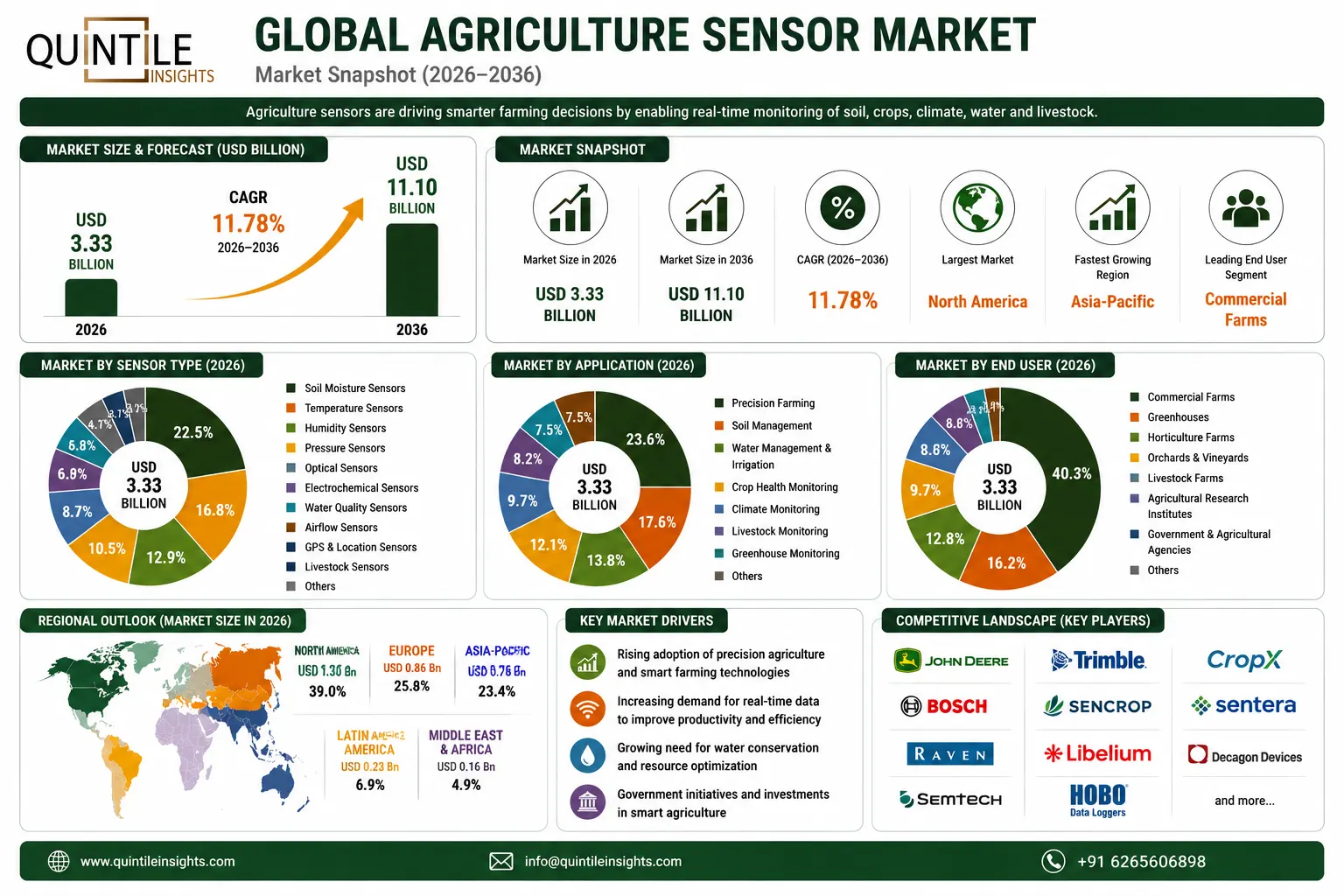
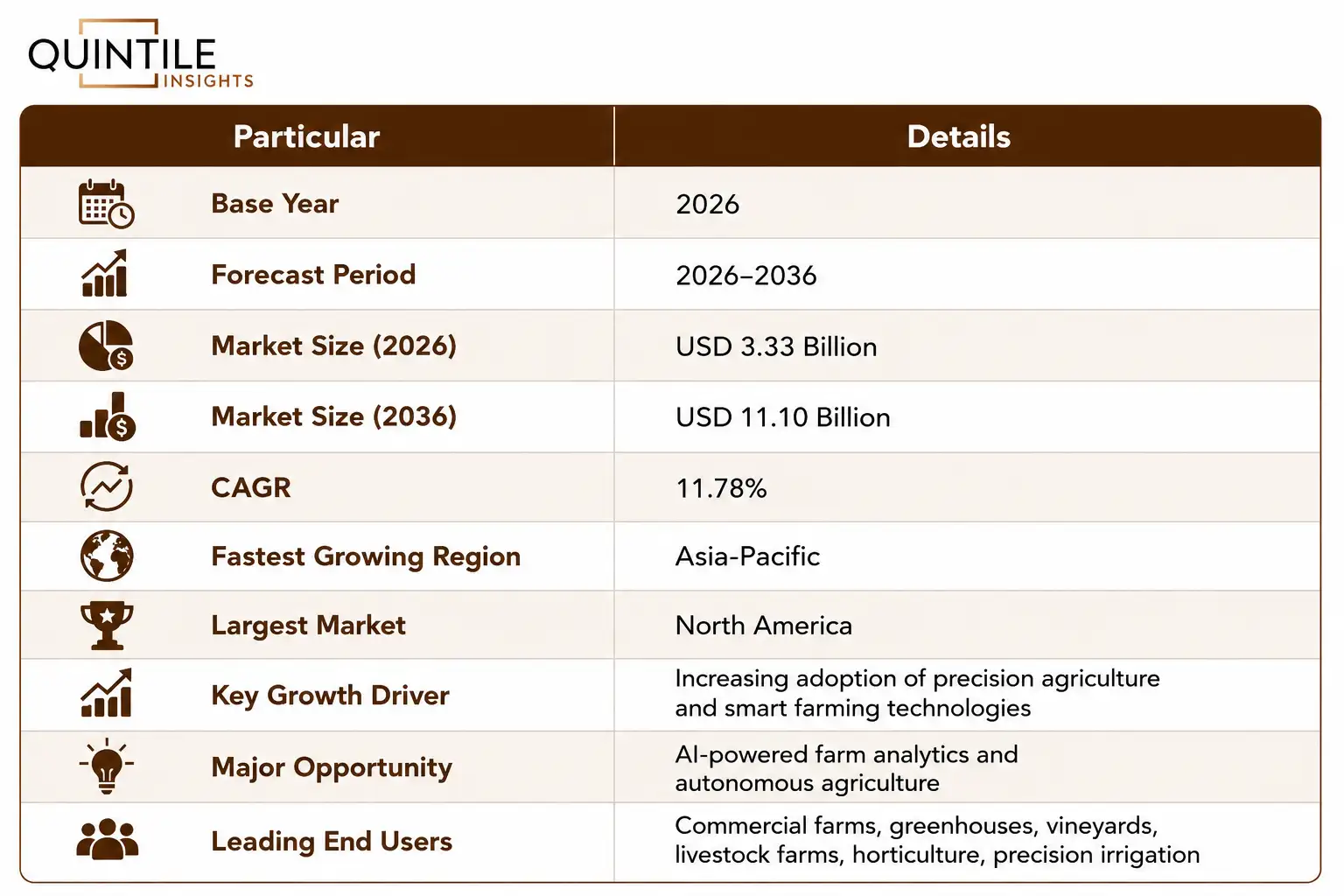
The Global Agriculture Sensor Market was valued at USD 3.33 Billion in 2026 and is projected to reach USD 11.10 Billion by 2036, expanding at a CAGR of 11.78% during the forecast period.
Rapid digitalisation across agriculture, coupled with increasing investment in precision farming technologies, is driving demand for advanced sensing solutions worldwide. Farmers are increasingly adopting sensor-based monitoring systems to improve crop yield, reduce operational costs, optimise fertiliser application, minimise water wastage, and enhance overall farm productivity. The integration of agriculture sensors with Internet of Things (IoT) platforms, artificial intelligence, cloud computing, satellite imagery, drone surveillance, and farm management software has further expanded their commercial applications across both developed and emerging agricultural economies.
Climate variability continues to reshape agricultural practices worldwide. Increasing incidences of droughts, floods, irregular rainfall patterns, soil degradation, and water scarcity are encouraging governments and agricultural enterprises to invest in intelligent monitoring technologies capable of improving climate resilience. Agriculture sensors allow producers to continuously evaluate field conditions and respond proactively to environmental changes, reducing production risks while improving resource efficiency.
Growing concerns regarding global food security are also contributing to market expansion. According to international agricultural organisations, food production must continue increasing over the coming decades to support a growing global population while simultaneously reducing agriculture's environmental footprint. Precision agriculture supported by advanced sensor technologies enables producers to maximise productivity from existing farmland without proportionally increasing inputs such as water, fertilisers, or pesticides.
Technological innovation remains one of the strongest growth catalysts for the industry. Continuous improvements in semiconductor technology, wireless communication, low-power electronics, edge computing, machine learning algorithms, and cloud-based analytics have significantly enhanced the performance, durability, and affordability of agriculture sensors. Modern sensors now deliver highly accurate, real-time measurements while supporting predictive analytics and automated farm operations.
Commercial greenhouse operators, vertical farms, vineyards, orchards, dairy farms, and large-scale row crop producers are increasingly deploying integrated sensor networks to automate irrigation scheduling, nutrient management, disease detection, livestock monitoring, and environmental control systems. As labour shortages continue affecting agricultural operations across multiple regions, intelligent sensing technologies are becoming an important tool for improving operational efficiency and reducing dependence on manual field inspections.
Government initiatives supporting smart agriculture and digital farming continue to create favourable market conditions. Various national programmes promoting sustainable agriculture, water conservation, precision irrigation, carbon reduction, and digital transformation are encouraging wider adoption of agricultural sensing technologies through subsidies, research funding, and public-private partnerships.
Despite strong long-term growth prospects, several factors continue to limit market penetration. High installation costs, fragmented farm ownership structures, inadequate rural connectivity, interoperability challenges between hardware platforms, and limited technical awareness among small-scale farmers remain significant barriers in developing economies. However, declining hardware costs, improved wireless infrastructure, and growing availability of subscription-based digital agriculture platforms are expected to accelerate adoption throughout the forecast period.
Looking ahead, agriculture sensors are expected to evolve beyond simple monitoring devices into intelligent decision-support systems capable of autonomous field management. Future innovations integrating artificial intelligence, robotics, autonomous agricultural machinery, multispectral imaging, digital twins, and predictive agronomy are likely to redefine precision agriculture over the next decade. As farming increasingly shifts towards connected ecosystems driven by real-time analytics, agriculture sensors will play a central role in improving productivity, strengthening food security, enhancing climate resilience, and supporting sustainable agricultural development across global markets.
Executive Summary
Key Market Highlights
Increasing Adoption of Precision Agriculture
The growing need to optimise agricultural productivity while reducing operational costs is accelerating the adoption of precision farming technologies. Agriculture sensors provide continuous field intelligence that enables producers to apply water, fertilisers, and crop protection products only where and when required, improving both productivity and resource efficiency.
Expansion of IoT-Enabled Farming Ecosystems
Connected agriculture is becoming mainstream as farms integrate sensors with cloud platforms, drones, weather stations, GPS systems, and autonomous machinery. Real-time connectivity enables continuous monitoring, predictive analytics, and automated farm operations, improving overall decision-making.
Rising Demand for Sustainable Resource Management
Increasing pressure to conserve water resources and minimise environmental impact has accelerated the deployment of soil moisture, climate, and nutrient sensors. These technologies help optimise irrigation schedules, reduce fertiliser losses, and support sustainable agricultural practices.
Artificial Intelligence Creating New Growth Opportunities
Artificial intelligence is transforming agriculture sensors from passive monitoring devices into intelligent decision-support systems. Machine learning algorithms analyse sensor-generated datasets to predict crop diseases, optimise irrigation timing, estimate yields, and recommend agronomic interventions before productivity losses occur.
Asia-Pacific Emerging as the Fastest-Growing Regional Market
Rapid agricultural modernisation, government-led digital farming initiatives, expanding food demand, and increasing investments in smart farming technologies are expected to position Asia-Pacific as the fastest-growing regional market throughout the forecast period.
Research Methodology
Reliable market intelligence requires a structured research framework that combines extensive secondary research with in-depth primary validation and advanced forecasting techniques. The Global Agriculture Sensor Market report has been prepared using a multi-stage research methodology designed to ensure data accuracy, consistency, and credibility. The study evaluates historical developments, current industry dynamics, technological advancements, regulatory developments, and future market opportunities across the global agriculture sensor ecosystem.
The research process incorporates quantitative analysis, qualitative insights, industry benchmarking, and expert validation to provide stakeholders with actionable business intelligence. Every market estimate and forecast presented in this report has been cross-verified through multiple independent sources to minimise statistical deviations and improve forecasting precision.
Secondary Research
Secondary research formed the foundation of the market assessment. Extensive information was collected from publicly available and subscription-based sources to understand industry developments, technological advancements, regulatory policies, investment activities, and competitive positioning.
Researchers analysed information from:
- Annual reports and investor presentations of leading agriculture technology companies
- Government agriculture departments and statistical agencies
- International organisations such as FAO, USDA, OECD, World Bank, European Commission, and CGIAR
- Precision agriculture associations and smart farming initiatives
- Scientific journals, white papers, patents, and technical publications
- Trade magazines and industry newsletters
- Company press releases and product launch announcements
- Financial databases and corporate filings
- Agricultural technology conferences and symposium proceedings
The collected information was organised, compared, and evaluated to identify market trends, technological innovations, demand patterns, regional developments, and emerging business opportunities.
Primary Research
Following the completion of secondary research, extensive primary interviews were conducted to validate assumptions, assess market trends, and gather first-hand industry perspectives.
Primary research involved discussions with:
Supply-Side Participants
- Agriculture sensor manufacturers
- Semiconductor suppliers
- IoT solution providers
- Precision agriculture technology companies
- Farm equipment manufacturers
- Software platform developers
- System integrators
- Agricultural drone companies
Demand-Side Participants
- Commercial farmers
- Greenhouse operators
- Plantation owners
- Dairy farm managers
- Agricultural cooperatives
- Irrigation consultants
- Government agriculture agencies
- Research institutions
- Agronomists
- Precision farming consultants
Interviews were conducted through virtual meetings, structured questionnaires, telephonic discussions, and email interactions. Insights gathered from industry experts helped validate market size estimates, technology adoption rates, pricing trends, purchasing behaviour, investment priorities, and future demand outlook.
Market Size Estimation
The Global Agriculture Sensor Market size has been estimated using a combination of bottom-up and top-down analytical approaches.
Bottom-Up Approach
Revenue generated by major agriculture sensor manufacturers and technology providers was analysed across different product categories, applications, and geographical regions. Company revenues were consolidated, adjusted for private market participants, and extrapolated to estimate the overall market size.
Top-Down Approach
Macro-level agricultural expenditure, precision farming adoption, digital agriculture investments, sensor deployment rates, and regional technology penetration were evaluated to estimate the addressable market. The derived estimates were compared with bottom-up calculations to ensure consistency and minimise forecasting bias.
Data Triangulation
To improve statistical reliability, all market estimates underwent a comprehensive data triangulation process.
Information collected from secondary research, primary interviews, financial analysis, and regional market assessments was compared and reconciled before finalising market figures.
The triangulation process helped eliminate inconsistencies arising from:
- Variations in company reporting
- Regional market fluctuations
- Technology adoption differences
- Product classification overlaps
- Supply chain distortions
- Inflation-adjusted pricing differences
Only validated datasets were incorporated into the final market model.
Forecasting Methodology
Market forecasts covering the period from 2026 to 2036 were developed using a combination of statistical modelling and industry-specific forecasting techniques.
Forecast assumptions considered multiple macroeconomic and industry-specific indicators, including:
- Global agricultural production trends
- Precision farming adoption rates
- Expansion of smart irrigation systems
- Digital agriculture investments
- Government support programmes
- Technological innovation cycles
- Climate adaptation initiatives
- IoT infrastructure development
- Semiconductor availability
- Farm mechanisation trends
- Capital expenditure across commercial agriculture
Advanced forecasting models were applied to estimate future revenue growth under baseline market conditions while accounting for expected technological disruptions and evolving regulatory environments.
Market Segmentation Framework
The report evaluates the Global Agriculture Sensor Market across multiple dimensions to provide comprehensive business insights.
By Sensor Type
- Soil Moisture Sensors
- Temperature Sensors
- Humidity Sensors
- Electrochemical Sensors
- Optical Sensors
- Pressure Sensors
- Water Sensors
- Livestock Sensors
- Airflow Sensors
- Mechanical Sensors
- GPS and Location Sensors
- Other Agriculture Sensors
By Application
- Precision Farming
- Soil Management
- Climate Monitoring
- Water Management
- Irrigation Automation
- Livestock Monitoring
- Smart Greenhouses
- Crop Health Monitoring
- Yield Monitoring
- Others
By Farm Type
- Open Field Farming
- Greenhouse Farming
- Indoor Vertical Farming
- Plantation Farming
- Dairy Farms
- Horticulture
- Orchard Farming
By Connectivity
- Wired Sensors
- Wireless Sensors
- IoT-Connected Sensors
By Region
- North America
- Europe
- Asia-Pacific
- Latin America
- Middle East & Africa
Currency and Pricing Considerations
All market values are presented in USD Billion unless otherwise specified.
Historical pricing trends, inflationary impacts, exchange rate movements, semiconductor cost fluctuations, and regional procurement practices have been considered while developing market estimates. Forecast values represent nominal market revenues based on prevailing economic conditions during the study period.
Assumptions and Limitations
The market assessment has been developed using the most reliable information available at the time of research. Forecasts assume no extraordinary geopolitical disruptions, prolonged global economic crises, or unforeseen regulatory interventions that could significantly alter industry growth trajectories.
While every effort has been made to ensure analytical accuracy, future market performance may vary depending on technological breakthroughs, policy changes, supply chain dynamics, climatic conditions, and evolving agricultural investment patterns.
Quality Assurance Framework
To maintain analytical integrity, the report follows a rigorous quality assurance process comprising:
- Multi-level data verification
- Independent analyst review
- Statistical consistency checks
- Cross-source validation
- Editorial quality assessment
- Forecast sensitivity analysis
- Industry expert validation
This structured approach ensures that the report delivers reliable, transparent, and decision-oriented market intelligence suitable for business strategy, investment planning, competitive benchmarking, and long-term market assessment.
Global Agriculture Sensor Market Dynamics
The global agriculture sensor market is undergoing a transformative phase as digital technologies become deeply integrated into modern farming operations. Increasing pressure on agricultural productivity, coupled with growing concerns over water scarcity, climate variability, and food security, is encouraging producers to adopt intelligent sensing solutions across the farming value chain. Agriculture sensors are no longer viewed as standalone monitoring devices but as strategic components of connected farming ecosystems that enable precision agriculture, automated irrigation, predictive crop management, and data-driven decision-making.
The market's growth trajectory is shaped by multiple structural factors, including technological innovation, supportive government policies, increasing investments in AgTech, and the rapid evolution of artificial intelligence (AI), Internet of Things (IoT), robotics, and cloud-based farm management systems. At the same time, challenges related to infrastructure, affordability, interoperability, and digital literacy continue to influence the pace of adoption across different regions.
Market Drivers
Rising Adoption of Precision Agriculture
Precision agriculture has become one of the most influential drivers accelerating the adoption of agriculture sensors worldwide. Farmers are increasingly relying on site-specific crop management practices to maximise productivity while reducing unnecessary input costs. Sensors installed across fields provide continuous information on soil moisture, nutrient availability, temperature, humidity, salinity, and crop health, enabling producers to optimise irrigation schedules, fertiliser application, and pest management.
The ability to collect real-time field data improves operational efficiency, reduces production variability, and supports sustainable agricultural practices. As precision agriculture expands across commercial farming operations, demand for intelligent sensing technologies is expected to increase significantly.
Growing Integration of IoT and Smart Farming Technologies
The rapid expansion of Internet of Things (IoT) infrastructure is transforming traditional farming into interconnected digital ecosystems. Modern agriculture sensors continuously communicate with cloud platforms, GPS-enabled equipment, weather stations, drones, autonomous machinery, and mobile applications, creating an integrated farm management environment.
IoT-enabled sensor networks provide farmers with remote visibility into field conditions, allowing faster decision-making and automated responses to changing environmental conditions. The increasing affordability of wireless communication technologies and cloud computing solutions continues to strengthen this growth driver.
Increasing Demand for Water Conservation and Efficient Irrigation
Agriculture accounts for the largest share of freshwater consumption globally, making efficient water management a critical priority for governments and farming communities. Agriculture sensors help optimise irrigation by continuously measuring soil moisture, evapotranspiration rates, groundwater availability, and climatic conditions.
Smart irrigation systems equipped with sensor technology significantly reduce water wastage while maintaining optimal crop growth. As water scarcity intensifies across many agricultural regions, investment in sensor-based irrigation management solutions is expected to accelerate.
Rising Focus on Sustainable Farming Practices
Growing environmental concerns and stricter sustainability regulations are encouraging agricultural producers to minimise chemical usage, improve soil health, and reduce greenhouse gas emissions. Agriculture sensors support sustainable farming by enabling precise application of fertilisers, pesticides, and irrigation water based on actual field requirements rather than conventional estimation methods.
This precision reduces environmental pollution while improving long-term soil productivity, making sensor technologies an essential component of climate-smart agriculture.
Technological Advancements in Sensor Technology
Continuous innovation in semiconductor manufacturing, wireless communication, artificial intelligence, microelectronics, and battery technologies has significantly improved the reliability and affordability of agriculture sensors.
Modern sensors offer:
- Higher measurement accuracy
- Longer operational lifespan
- Lower energy consumption
- Remote connectivity
- AI-enabled predictive analytics
- Edge computing capabilities
- Real-time monitoring
- Cloud integration
These technological improvements continue to broaden the commercial adoption of agriculture sensors across diverse farming systems.
Government Support for Agricultural Digitalisation
Governments worldwide are actively promoting precision agriculture through subsidies, digital agriculture missions, smart irrigation programmes, and climate adaptation initiatives. Financial incentives encouraging farmers to adopt modern agricultural technologies are reducing investment barriers and expanding market penetration.
National food security strategies, water conservation programmes, and carbon reduction policies are expected to further strengthen long-term market growth.
Market Restraints
High Initial Capital Investment
Despite long-term operational benefits, agriculture sensor systems require considerable upfront investment in hardware, installation, software integration, connectivity infrastructure, and maintenance.
Large commercial farms are generally better positioned to absorb these costs, whereas small and medium-sized farmers often face financial constraints that limit adoption.
Limited Digital Infrastructure in Rural Areas
Many agricultural regions continue to experience inadequate internet connectivity, unstable power supply, and limited access to cloud infrastructure. Since modern agriculture sensors increasingly rely on wireless communication and real-time data transmission, insufficient digital infrastructure can restrict system performance and delay technology adoption.
Developing economies are particularly affected by these infrastructure challenges.
Lack of Technical Knowledge Among Farmers
Successful implementation of precision agriculture requires technical understanding of sensor calibration, data interpretation, and digital farm management platforms. Limited awareness and insufficient technical training remain significant barriers, especially in emerging agricultural markets where conventional farming practices continue to dominate.
Sensor Calibration and Maintenance Challenges
Agriculture sensors operate under harsh environmental conditions including dust, moisture, extreme temperatures, and chemical exposure. Maintaining long-term measurement accuracy requires periodic calibration, maintenance, and occasional replacement.
These ongoing operational requirements may increase total ownership costs for farmers.
Interoperability Issues Across Digital Platforms
Modern farms often deploy equipment from multiple technology providers. However, differences in communication protocols, software compatibility, and proprietary platforms can create integration challenges between sensors, farm management software, autonomous equipment, and cloud services.
Improving interoperability remains an important industry priority.
Market Opportunities
Expansion of Artificial Intelligence in Agriculture
Artificial intelligence is creating new commercial opportunities for agriculture sensor manufacturers. AI-powered analytics platforms convert raw sensor data into actionable recommendations regarding irrigation scheduling, fertiliser optimisation, disease prediction, and harvest planning.
As predictive agriculture becomes increasingly sophisticated, demand for high-quality sensor data will continue expanding.
Growth of Autonomous Agricultural Machinery
Autonomous tractors, robotic harvesters, precision sprayers, and unmanned ground vehicles rely extensively on sensor networks for navigation, environmental monitoring, obstacle detection, and operational control.
Increasing investment in agricultural automation presents substantial long-term growth opportunities for sensor manufacturers.
Rapid Expansion of Smart Greenhouses
Controlled-environment agriculture is experiencing rapid expansion due to growing demand for year-round food production. Greenhouse operators increasingly deploy integrated sensor systems to monitor temperature, humidity, CO? concentration, lighting, irrigation, and nutrient delivery.
The continued development of smart greenhouse infrastructure is expected to generate significant market demand.
Increasing Adoption of Carbon Farming
Carbon credit programmes and regenerative agriculture initiatives require continuous monitoring of soil health, carbon sequestration, and environmental conditions.
Agriculture sensors are expected to play an increasingly important role in supporting carbon accounting, sustainability reporting, and environmental compliance.
Emerging Markets Driving Future Growth
Countries across Asia-Pacific, Latin America, the Middle East, and Africa are rapidly investing in agricultural modernisation. Expanding government support, improving connectivity infrastructure, and rising awareness regarding precision agriculture are creating attractive opportunities for global sensor manufacturers.
Market Challenges
Fragmented Agricultural Land Holdings
Many developing countries consist primarily of small and fragmented farms where large-scale deployment of precision agriculture technologies remains economically challenging.
Cybersecurity and Data Privacy Concerns
As agriculture becomes increasingly digital, concerns surrounding cyberattacks, data ownership, and privacy continue to grow. Protecting sensitive farm data has become an important consideration for technology providers and agricultural enterprises.
Supply Chain Disruptions
Agriculture sensor manufacturing depends heavily on semiconductor components, electronic assemblies, batteries, and communication modules. Global supply chain disruptions, raw material shortages, and logistics constraints can influence production costs and product availability.
Climate Extremes Affecting Sensor Reliability
Flooding, prolonged droughts, extreme heat, and severe weather events may reduce sensor lifespan and affect operational accuracy, requiring more robust product designs for challenging agricultural environments.
Return on Investment Concerns
While agriculture sensors improve long-term efficiency, many farmers remain cautious regarding investment payback periods, particularly where farm profitability is influenced by fluctuating commodity prices and unpredictable weather conditions.
Market Opportunity Analysis
The agriculture sector is entering an era of intelligent automation, where connected sensors, AI-driven analytics, autonomous equipment, and cloud-based decision support systems will increasingly replace conventional farming practices. Future market expansion will be supported by:
- AI-assisted precision farming
- Autonomous agricultural machinery
- Smart irrigation infrastructure
- Regenerative agriculture initiatives
- Carbon farming programmes
- Digital twin technology for agriculture
- Edge AI and real-time analytics
- Robotics-enabled crop monitoring
- Satellite-integrated sensor ecosystems
- Climate-resilient farming solutions
As agriculture continues its digital transformation, sensor technologies are expected to become the foundational infrastructure enabling sustainable, productive, and resilient food production systems worldwide.
PESTLE Analysis
Political
Government initiatives promoting precision agriculture, digital farming, smart irrigation, and sustainable agriculture are driving the adoption of agriculture sensors. Financial incentives, subsidies, and investments in agricultural modernization further support market growth.
Economic
Rising global food demand, increasing farm mechanization, and investments in AgTech solutions are encouraging farmers to adopt sensor-based technologies. However, high initial deployment costs remain a challenge for small-scale farmers.
Social
Growing awareness of food security, sustainable farming, and efficient resource management is accelerating the use of smart farming technologies. Farmers are increasingly adopting data-driven agricultural practices to improve productivity and crop quality.
Technological
Advancements in IoT, AI, cloud computing, GPS, drone technology, edge computing, and wireless communication have significantly enhanced the accuracy and functionality of agriculture sensors, enabling real-time farm monitoring and predictive analytics.
Legal
Government regulations related to water conservation, environmental protection, food safety, and sustainable agriculture encourage the adoption of precision farming technologies. Data privacy and cybersecurity regulations are also becoming increasingly relevant for connected farming systems.
Environmental
Climate change, water scarcity, soil degradation, and the need to reduce greenhouse gas emissions are driving demand for agriculture sensors. These technologies help optimize irrigation, minimize chemical usage, and promote sustainable resource management.
Porter's Five Forces Analysis
Threat of New Entrants - Moderate
High R&D investments, technological expertise, and regulatory requirements create entry barriers, although increasing demand continues to attract new AgTech startups.
Bargaining Power of Suppliers - Moderate
Dependence on semiconductor manufacturers, electronic component suppliers, and communication technology providers gives suppliers moderate bargaining power.
Bargaining Power of Buyers - High
Large commercial farms and agribusinesses have multiple technology options, enabling them to negotiate pricing and demand customized sensor solutions.
Threat of Substitutes - Low to Moderate
Traditional farming methods remain in use but cannot provide the real-time monitoring and data accuracy offered by advanced agriculture sensors.
Competitive Rivalry - High
The market is highly competitive, with leading companies focusing on product innovation, AI integration, strategic partnerships, acquisitions, and geographic expansion to strengthen their market position.
Competitive Landscape
The global agriculture sensor market is moderately consolidated, with leading companies competing through technological innovation, product portfolio expansion, strategic collaborations, acquisitions, and geographic expansion. Market participants are increasingly investing in AI-powered analytics, IoT-enabled sensor platforms, cloud-based farm management solutions, and precision agriculture technologies to strengthen their competitive position. Partnerships with agricultural equipment manufacturers, software developers, and government organisations continue to create new growth opportunities while enhancing product adoption across commercial farming operations.
Mergers & Acquisitions
The agriculture sensor market has witnessed increasing merger and acquisition activity as companies seek to expand technological capabilities, strengthen digital agriculture portfolios, and enhance their global presence. Strategic acquisitions have enabled organisations to integrate artificial intelligence, remote sensing, IoT platforms, and data analytics into comprehensive precision farming solutions. Industry participants are also entering collaborative partnerships with agricultural equipment manufacturers, software providers, and research institutions to accelerate innovation and improve market competitiveness.
Recent Developments
- September 2025: CropX Technologies expanded its precision agriculture platform by introducing advanced AI-powered soil sensing capabilities, enabling farmers to optimize irrigation scheduling, nutrient management, and crop health monitoring through real-time field intelligence.
- July 2025: Deere & Company strengthened its precision farming portfolio by integrating next-generation sensor technologies with autonomous machinery and cloud-based farm management systems, enhancing operational efficiency and data-driven decision-making.
- May 2025: Trimble Inc. introduced upgraded agriculture sensing and positioning solutions featuring enhanced GNSS accuracy and IoT connectivity to improve precision planting, field mapping, and variable-rate application.
- March 2025: Sentera launched advanced multispectral imaging and sensor solutions designed to improve crop scouting, early disease detection, and yield estimation through drone-based precision agriculture applications.
- January 2025: Soil Scout expanded its wireless underground soil moisture monitoring portfolio with long-life sensor technology, enabling continuous field monitoring while reducing maintenance requirements for commercial farming operations.
About the Author(s)
Agriculture & Smart Technologies Research Team
Agriculture · AgTech · Sensors & Smart Farming
This report was authored by the Agriculture & Smart Technologies Research Team at Quintile Insights, comprising experienced market research analysts, senior industry consultants, and domain specialists with expertise in precision agriculture, smart farming technologies, agricultural IoT, sensing solutions, and digital agriculture ecosystems. The team combines extensive primary research, secondary intelligence, proprietary market modelling, and industry expertise to deliver comprehensive market assessments and strategic business insights.
All findings presented in this report are based on proprietary research methodologies, in-depth executive interviews, government and regulatory publications, company disclosures, industry databases, and rigorous data triangulation. Each report undergoes a comprehensive editorial and analytical review process to ensure the highest standards of accuracy, reliability, and consistency before publication.
Last Updated: July 2026
Frequently Asked Questions
Choose License Type

Personalize Research
- Request for free customization
- Buy country specific report
- Ask for Subscription Package
- Ask special pricing
- Ask for Analyst call support
Get in Touch
+91-619-645-6280
+44-219-314-7779
sales@quintileinsights.com